
The Eternal Mandate: Mapping the North Korean Constitution
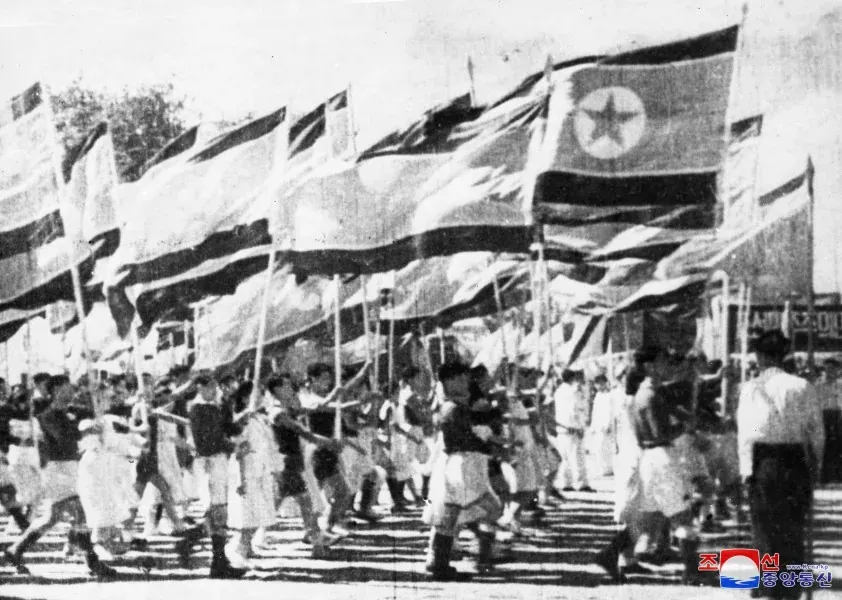
May 9, 1948 - North Korean Constitution Formally Adopted
Drafted in April and adopted at the First Supreme People’s Assembly in September 1948, the founding constitution of the Democratic People’s Republic of Korea established a governance structure heavily modeled on the 1936 Soviet “Stalin” Constitution. Consisting of ten chapters and 104 articles, it set out basic state principles; the rights and duties of citizens; the organization of central and local legislative, executive, and judicial organs; budgetary and national defense provisions; amendment procedures; and symbols of statehood. At its core, the constitution elevated the Supreme People's Assembly (SPA) as the highest organ of state authority and the sole source of power for all other constitutional bodies, mirroring the structure of the Supreme Soviet of the Soviet Union. The SPA exercised exclusive legislative authority and was empowered to enact domestic and foreign policy, revise the constitution, approve the national budget, elect or recall the Premier and Cabinet members, appoint senior judicial and prosecutorial officials, and manage foreign service appointments, although candidates for election were carefully screened by the party in advance. The Cabinet, led by Premier Kim Il-sung, functioned as the executive and administrative arm of the state, while a network of local People’s Committees extended authority to provincial, city, and county levels. No system of checks and balances was intended; in practice, the SPA’s supremacy was largely formal, as its Presidium—composed of top party elites—initiated most policymaking, acted as head of state when the Assembly was not in session, and exercised associated ceremonial authority. Notably, the constitution defined the DPRK as a “people’s democracy” transitioning toward socialism, made no reference to Juche, and remained in force for 24 years with only minor amendments, until replaced by the 1972 Socialist Constitution. The 1948 Constitution provided the early legal scaffolding for a centralized system that would later evolve into the monolithic Suryong order.
The 1948 Constitution also set out an extensive catalogue of citizens’ rights, formally guaranteeing a range of civil and political freedoms that closely resembled those found in liberal democratic systems. These included freedom of speech (Article 13), equal protection under the law (Article 11), the right to vote and to be elected (Article 12), freedom of religion (Article 14), protections for privacy (Article 21), safeguards against arbitrary arrest (Article 24), and the right to petition state authorities (Article 25). Whether these rights were meaningfully protected in practice remains uncertain, but their inclusion is significant: despite its Soviet lineage, the constitution retained notable non-socialist elements. In particular, it broadly protected private ownership and imposed tax obligations calibrated to citizens’ ability to pay, underscoring the regime’s self-characterization as a “people’s democracy” in a transitional, rather than fully socialist, phase.