
The Order to "Erase" Unification and the "Hostile State" Revision
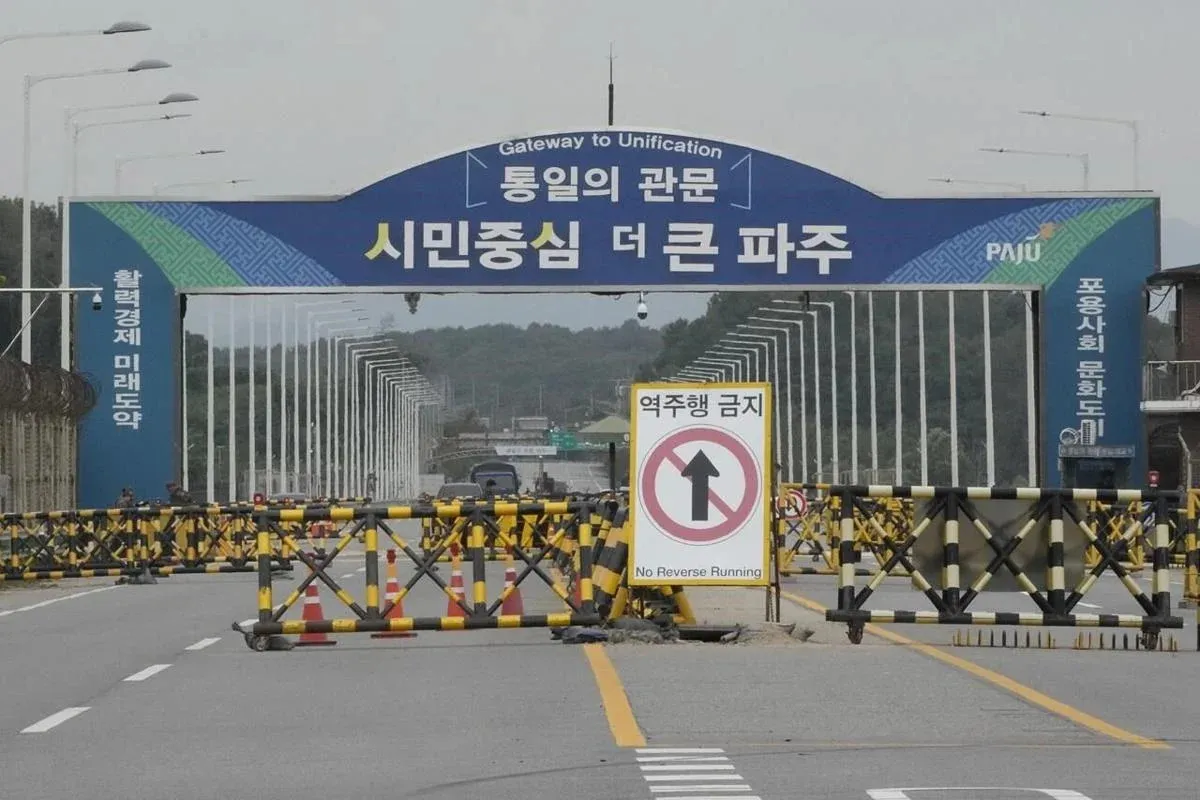
The 2024 revisions represent a seismic shift in North Korean constitutional law. For over 75 years, every version of the constitution—even at the height of the Cold War—maintained that the North and South were "one people" temporarily divided, with "peaceful reunification" as the ultimate sacred goal.
In 2024, Kim Jong Un legally abolished that concept to insulate his regime from South Korean cultural and political influence.
January 2024: The Order to "Erase" Unification
During a speech at the 10th Session of the 14th Supreme People’s Assembly (SPA), Kim Jong Un shocked observers by ordering a total rewrite of the state’s national identity. He declared that South Korea was no longer a "partner for reconciliation" but the "invariable principal enemy."
- The Linguistic Purge: He ordered the removal of terms like "3,000-ri tapestry-like land" (a traditional poetic name for a unified Korea) and "80 million compatriots" from the constitution.
- Defining Territory: He demanded the constitution precisely define North Korea’s sovereign territory, explicitly rejecting the Northern Limit Line (NLL) (the de facto sea border) and stating that any violation of "even 0.001 mm" would be a declaration of war.
- Annexation Clause: He proposed adding a clause that mandates the "complete occupation, subjugation, and annexation" of the South into the DPRK in the event of war.
October 2024: The "Hostile State" Revision Confirmed
Following months of high tension—including the North blowing up the inter-Korean road and rail links—state media (KCNA) confirmed that the SPA had officially amended the Socialist Constitution.
- Defining the ROK as "Hostile": The revised text now "clearly defines" the Republic of Korea (South Korea) as a "hostile state." This is the first time in history the South has been legally categorized as a foreign enemy nation rather than a "special relationship" based on shared ethnicity.
- Legalizing the Separation: The revision provided the constitutional basis for the military to physically and permanently "fortify" the southern border. By defining the South as a separate, hostile power, Kim Jong Un removed the legal and ideological obligation to seek a peaceful merger.
- The "Two-State" Reality: This amendment effectively institutionalizes a "Two Koreas" policy, treating South Korea the same way it treats the United States or Japan—as a foreign threat to be deterred by the "Nuclear Mandate" of 2023.
The 2024 revisions served three main legal and strategic purposes:
- Legalizing Nuclear War on the South: Previously, using nuclear weapons on "compatriots" was ideologically difficult to justify. By defining South Koreans as "foreign enemies," the 2023 Nuclear Mandate can now be legally applied to them without contradiction.
- Cultural Insulation: By declaring that North and South are no longer the same people, Kim Jong Un created a legal barrier against the "Korean Wave" (K-Dramas, K-Pop). If they aren't the same people, North Koreans have no business consuming South Korean culture.
- Ending "Reunification by Absorption": The regime feared that as long as "unification" was a goal, the much wealthier South would eventually "absorb" the North. By deleting unification from the law, Kim legally barricaded his regime against any peaceful merger.