
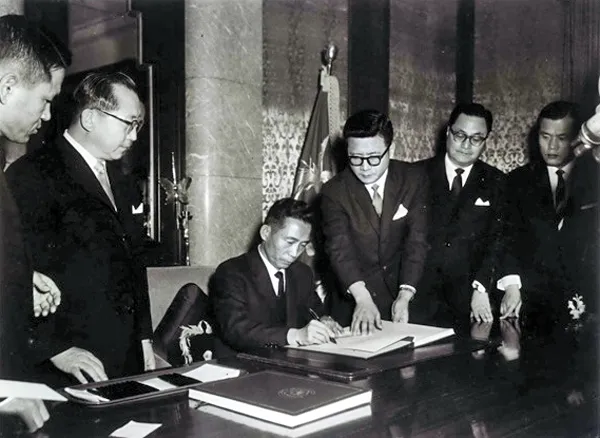
The 1965 Agreement
The modern dispute begins with the 1951 San Francisco Peace Treaty (SFPT).
- Article 14: Established the "Waiver of Claims" model for Allied Powers. View Text (UN)
- Article 4: Specifically mandated that the "disposition of property and claims" between Japan and Korea be resolved through "special arrangements," directly leading to the 1965 negotiations.
The Scope of the Settlement: State vs. Individual Rights
Does "State-to-State" settlement extinguish "Individual" rights? A central tension in the interpretation of the 1965 Agreement is whether a state can legally waive the private claims of its citizens.
Primary Sources:
- Article II of the 1965 Claims Settlement Agreement ("settled completely and finally").
- Nishimatsu Construction Co. v. Song Jixiao et al., Japan Supreme Court (2007). Summary: The Court ruled that while "substantive rights" to compensation may still exist, the 1965 Treaty resulted in the loss of the "power to litigate" (the procedural right to sue) in court.
- The "Eight-Point Outline" (1961). Declassified in 2005, these records show the Park Chung-hee administration specifically requested compensation for "requisitioned workers" (Item 5), which Japan argues proves the intent to settle these exact claims.
Shigeru Oda provides the most accurate English summary of the "Eight-Item Outline" used during the talks in his article "The Normalization of Relations between Japan and the Republic of Korea," The American Journal of International Law 61, no. 1 (1967): 35–56.
Related Secondary Resources
- Timothy Webster, “Japan’s Transnational War Reparations Litigation: An Empirical Analysis,” Harvard International Law Journal 63, no. 1 (2022): 18.
- Hideki Okuzono, “South Korean Judiciary Shakes Japan-South Korea Relations,” Japan Institute of International Affairs, JIIA Digital Library, 2016. This article provides the Japanese legal perspective on why the 1965 Treaty must be absolute. It analyzes the "Power to Litigate" theory from the 2007 Nishimatsu ruling, explaining that while an individual might still have a "moral" right, the 1965 Treaty legally removed their ability to use a courtroom to enforce it.
- Pae-Keun Park, "The 1965 'Korea-Japan Claims Settlement Agreement' and Individuals' Claims Rights," Kyushu University Publications (2000): 67–103. This article examines the legal debate over whether the 1965 agreement between South Korea and Japan extinguished the rights of individuals to seek compensation for colonial-era grievances.
- Nicholas S. Richard, “Waivers of Individual Claims via Treaty: Chinese Slave Laborers, Japanese Jurisprudence, and the Solution of the European Court of Human Rights,” 34 Brooklyn Journal of International Law 239 (2008). Richard defends the traditionalist view that for international peace to be "final," sovereign states must have the legal authority to waive the private claims of their citizens.
Select Media Coverage
- https://focustaiwan.tw/cross-strait/202512020012
- https://www.koreatimes.co.kr/opinion/20170427/the-san-francisco-peace-treaty-and-territorial-sovereignty
- https://www.taiwannews.com.tw/news/6257158
- https://thediplomat.com/2020/10/the-japan-korea-dispute-over-the-1965-agreement/
- https://www.koreatimes.co.kr/foreignaffairs/others/20250615/so-close-yet-so-far-s-korea-japan-ties-at-pivotal-moment-60-years-after-normalization